Wednesday, March 7, 2012

A Little More in the Same Vein


     This was in the same pile as the RLDS Church Directory that was in the last post.  If you look directly above the "IA" in the caption, there is a large box.  I happened to zoom on that part of the photo and this is what I found: 
                                                                                                                                                                                                                                                                                                                                                                                                                                                                                                                                               

      The sign on the side says "gasolene," so it must be an early gas pump.  I have never seen anything similar.  I wonder how many cars were in Moorhead, IA during the second decade of the twentieth century. Were the farmers using tractors and others gas-powered equipment? 

      Along with the ad for the McIntyre Drugstore, I'm reposting the fan.  Here's a little piece of ephemera, designed to be thrown away, but instead stuck in a drawer.  It amazes me that a piece of cheap paper has survived so long. 


1910 RLDS Directory


       I found this directory among some family photos.  Moorhead is a tiny town in Monona County, IA  northeast of Omaha, NE.  The early histories of Monona and Harrison Counties list the McIntyres, the Frys, the Adams, and the Manns.  All are related to us. 


A. (Ammon) McIntyre was Grandpa Earl Mc's father who is listed on this page as the Presiding Teacher of the church.  The clerk was Mrs. Perry Mann.  Louella Wilson Mann married Ammon after the deaths of their respective spouses.  My mother and her siblings referred to her as "Grandma Lou."


      In an earlier post, I stated that the McIntyres were back in Iowa by 1910.  Here is the ad for the drugstore and in the following pages, the family members are named as members of the church.


      Even if my surname was Outhouse, I don't think I would use it as the name for my real estate business, and  I also don't think the slogan would be "Make this Real Estate office your Headquarters." 


Thursday, March 1, 2012

Helenwood, Tennessee

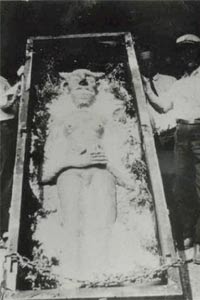
     An eccentric, enterprising relative is believe to be responsible for the “Helenwood” name given to a small town in Scott County, Tennessee. The name, so the story goes, was shortened from “Hell in the Woods,” referring to the time when a demon was discovered buried in a shallow grave. Well, maybe...
     Reuben Crusoe Sexton was the son of Christopher Columbus Sexton and Sarah West. Sallie Sexton’s father was also Christopher, but her mother was Nancy Phillips.

     While in the army, “Cruise” saw huge, monstrous statues and upon his return to Tennessee, he decided to create his own sculpture. Using bed clay located near an abandoned coal mine, he painstakingly made a detailed figure, spending years on detail work. With horns, a large head, and long arms, the figure appeared so vicious that Sexton fashioned a chain around the creature’s neck. Wings reached almost to its feet. Twenty-four teeth were visible in large mouth. The statue even sported clay genitals.

     Fearing her son had a still hidden in the woods, Cruise’s mother followed him to the mine. (From what I’ve heard, moonshine was a popular way for some of the Tennessee Sextons to get a little extra cash.) Instead of liquor, Mom found a “demon” who frightened her so much that she started spreading the story of the horrible monster she’d seen. And our good, old boy figured the tales circulating could be profitable. He made up a story claiming that the creature had been found in July of 1921, under five feet of dirt in his backyard. He said that his belief was that he had unearthed an ancient idol.

     As the story of the devil spread, Sexton and his brother,Jerry Smith, put the devil in an oversized coffin and carried it to Jerry’s yard in town. Some said the creature weighed a ton, others claimed only five hundred pounds, but which ever it was, transporting it must have been a difficult task. Not so surprisingly, with a little help from Sexton, I’m sure, the tale of the demon became more exaggerated, and it was taken to Helenwood Railway Station where it was displayed. Twenty-five cents bought twenty-five minutes of viewing. By August of 1921, there was so much notoriety that the New York Times wrote two articles. People nationwide were travelling the rails to see Sexton's creation.


      In September of 1921, J.C. Pemberton of nearby Oneida, Tennessee paid two thousand dollars for the monster and immediately showed it in the Somerset Fair in Somerset, Kentucky. The demon was the top draw at the fair. A professor from an “Eastern School” espoused that the statue was an idol from an early race.  Cruise signed an affidavit stating that the statue was authentic while a guard watched over the casket now reinforced with four iron bands. Some supposedly fainted at the viewings, others claimed the demon was a fake. However, despite cries of fraud, Pemberton was able to bargain for a reported twenty-five thousand dollars sale to parties who showed it at the Chicago World’s Fair of 1923.

     After the Fair, the devil didn’t return to Scott County. Some said that it was put on display on in a small museum in the Northern United States. Others said  it disintegrated.
    
     For some odd reason (were people that naïve?), Cruise Sexton was never pegged as the source of the monster. Residents of Cruise’s hometown decided that the devil had visited their hometown because of the sins of the people who lived there. They pointed to the drinking, saloons, and violence as evidence and soon the little town was called “Hell in the Woods.” The name stuck.


Chart showing the relationship between my grandmother, Nancy Belle Waters, and Robinson Crusoe Sexton


     It would be wonderful if the stories I find had enough details to exactly pinpoint the people involved, especially the eccentric ones. However, many times, it comes down to a presumption and a hope that someone will help correct mistakes.

     I glanced down a record of military actions in China to see if I could determine which “Cruise” started his own lucrative business in an abandoned coal mine. In this case, an uncle, named Reuben Crusoe Sexton (b. 1872), and his nephew, Crusoe Reuben (b.1896) are the two most likely entrepreneurs. American soldiers were in China from the 1890’s to 1918. So either one could have visited there. As this tale dates from 1921, I thought that the younger came back from World War I, worked on the statue for three years, and then started selling tickets. On the other hand, I remember seeing somewhere that Sexton worked on it for seven years. If that is the case, the younger is ruled out. Also, Jerry Smith helped Cruise take his monster to town (and here I envision them dressing the creature in tails and a tophat). Jerry Smith was a brother to the elder, the two shared a mother. If I were to hang out and do something a little shady, my more likely companion would be my sibling, not my uncle.  So,  this account is written assuming the uncle was the sculptor.
                                                                                                                                            -Cheri


Monday, February 20, 2012

Large Graphics

I posted all the sources for James H. Waters in a huge size, hoping that you all can read them.
-Cheri

More Sources for James H. Waters

In 1920, Arlie lived in South Dakota and listed herself as "widowed."  James H., Great Grandpa's son, was eleven. 
In 1930, James H. was married to Adeline and living in Idaho.  He was a "laborer." 


 His World War I draft registration listing Basil (Nancy Belle's brother, born 1901) as his nearest relative. He's still in Idaho, but in a different county.

Here's the World War II registration in Josephine County, Oregon, where he stayed until his death.  It is interesting to notice the difference in signatures between this and the marriage license with Sallie.
Oregon State record listing James' death as April 20, 1960. Finally, one last record, showing his military service in the Spanish American War and the location of his grave.

Record of graves of Spanish American War members of the military: WATERS, JAMES, Pvt.,
2nd Tennessee Volunteer Infantry, Co. M (February 17, 1877 – April 20, 1960)(Granite Hill Cemetery, Grants Pass, Josephine Co., OR)

Sunday, February 19, 2012

Source Materials


     It's time to get back on track. Grandma Nancy Belle's father was James H. Waters, making him my great grandfather.  Here are the source materials.   
         A fire destroyed the majority of the 1890 U.S. Census.  For some reason, about 90% of it was outside it's fireproof vault, while every other census was protected from the flames. In the 1900 census, James was a "school teacher."


       And here is the license for James' marriage to my great grandmother, Sallie Sexton.  Notice that they married on February 14, 1900.

      
      And the license for his second marriage to Arlie Cross.  Notice the date.  It must have been easy to remember his anniversary!

So, in 1910, James was a civil engineer in Yakima, Washington, who listed himself as "widowed."

Tuesday, February 14, 2012

Jan Parcell and Judith Ytie Jans

If I counted correctly, this couple is back seven generations from Grandpa Mc. The dates, places, and names seem to line up with our ancestors, John (Jan) Purcell and Ytie Jan.  For those of us who have suffered through a divorce, this story makes our problems miniscule.

"November 25, 1658, John Parcell, alias Borcher, of Huntingdonshire, England for living in adultery with Ytie Jans, to be placed at the whipping post with two rods in his arms, to be banished for 20 years, and pay a fine of 100 guilders ($40), with costs. A petition submitted to the Council on December 12, 1658 by John Parcell and Ytie Jans, two sorrowful sinners, ask for pardon and leave to marry. The Council allowed them to remain three months to settle their affairs, but must separate from each other at once. Official records become strangely silent at this point, but Jan must have found a way to marry Ytie, since a wife by that name survived him and was his widow in 1684. They provided a home for their children from previous marriages and at least two of their own. (2) On June 13, 1674, Ytie was named as a sponsor at the baptism of Catharine, daughter of son Hans. Jan Parcell died in 1677, his will proved on September 28 of that year. Ytie, along with step-sons John and Thomas Parcell, appear on the rate list of Newtown in 1683. In March 1684 she petitioned the Council concerning a dispute over lands near Gravesend - the last time her name appears in the public records.

Source: http://www.jonathanpaul.org/genweb/d0001/g0000086.html

November 25, 1658 Judith Ytie Jans was sentenced to a whipping and banishment for living in adultery with Jan Parcell in New Amsterdam, New York. 

November 25, 1658 Laurens Duyts of Holstein received sentencing from Stuyvesant for selling his wife, Ytie Jansen and forcing her to live in adultery with another man, and for living himself in adultery, he was to have a rope tied around his neck, and then to be severely flogged, to have his right ear cut off, and to be banished for fifty years."

-Cheri